Cat body condition score chart (WSAVA 1–9)
A cat's body condition score rates its body fat from 1 to 9, and 5 is ideal (WSAVA). Lower scores mean too thin, higher scores mean overweight. You judge it by the ribs, waist and belly.
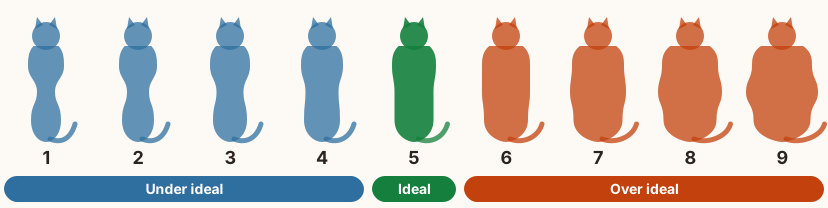
Which score matches your cat? Tap one:
All nine scores: ribs, waist and belly
Source: WSAVA
Each description is quoted from the chart. Tap the one closest to your cat.
Under ideal — score 1–4
Ideal — score 5
Over ideal — score 6–9
A guide to spotting change, not a diagnosis. Your vet can confirm the score and a target weight.
What is the ideal body condition score for a cat?
5 out of 9. A cat at 5 is well-proportioned: its ribs can be felt under a slight fat covering, a waist shows behind the ribs without being pronounced, and the belly fat pad is minimal.
What does 4 or 6 out of 9 mean?
Each is one step from ideal. At 4, the ribs have minimal fat covering, the waist is noticeable and the belly has a slight tuck. At 6, the ribs carry slight excess fat and the tuck is gone.
WSAVA adds that a score of 6 may be acceptable in some cats, especially older cats.
How do I check my cat's body condition at home?
Check three places in turn: the ribs, the waist and the belly. Then match what you find to the closest of the nine descriptions in WSAVA's chart.
- Ribs, by feel. Ideal: felt with a slight fat covering. Under ideal: felt with minimal fat covering, or easily seen on a short-haired cat. Over ideal: not easily felt, or not felt at all.
- Waist, from above. Ideal: seen behind the ribs but not pronounced. Under ideal: noticeable or obvious. Over ideal: not easily seen, or absent.
- Belly, from the side. Ideal: a minimal fat pad. Under ideal: an abdominal tuck. Over ideal: a rounded belly or a moderate to prominent fat pad.
How do I score a long-haired cat?
Go by feel. WSAVA's chart describes ribs as easily seen "on short-haired cats" at scores 1 and 2, so seeing the ribs is a short-hair cue. Use your hands on the ribs, waist and belly.
What should I do if my cat is overweight or underweight?
Talk to your vet. AAHA's 2021 guidelines say a score below 4 or above 5 should prompt a fuller check. Ask for a target weight, then work out calories for that weight, not today's.
Why do vets use a 9-point scale?
For consistency. AAHA recommends the 9-point scale, in whole numbers, for medical records, research and talks between vets and owners. Each point up the scale equals a 5% increase in body fat.
Related tools
Sources
How we choose them- WSAVA — Cats: Body Condition Score chart (PDF, 2025)
“Well-proportioned. Ribs felt with slight fat covering. Waist seen behind ribs, but not pronounced... A body condition score of 6/9 may be acceptable in some cats, especially older cats.”
- 2021 AAHA Nutrition and Weight Management Guidelines — body condition score (PDF)
“A BCS <4/9 or >5/9, MCS with any degree of loss, and unexplained weight change from the pet’s previous assessment should prompt an extended assessment... Every incremental increase in BCS is equivalent to a 5% increase in BF%”